| John Broskie's Guide to Tube Circuit Analysis & Design |
| 01 November 2008
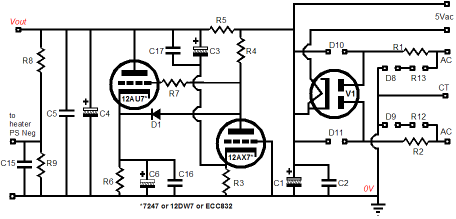
Janus Regulator PCB, Rev A
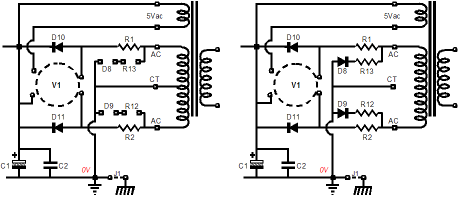
Moreover, the PCB now offers more rectifier options, as it can run a single tube rectifier (5Y3/5R4/5AR4) or hybrid setup which uses two solid-state rectifiers with the tube rectifier or four solid-state rectifiers for an entirely solid-state rectification. In addition, a bigger series resistor (5W to 12W instead of 3W) can be housed and the heater regulator can now fit a bigger heatsink. Below are the four possible rectifier configurations:
Above, we see the two setups that use a tube rectifier; below, the two all-solid-state versions.
The new Janus regulator PCB is shown below.
Because the new PCB is larger and now uses two more large, high-voltage film capacitors, the price went up tad, $12 USD. To purchase, please visit the GlassWare Yahoo Store at http://store.yahoo.com/glass-ware
UltraPath Push-Pull
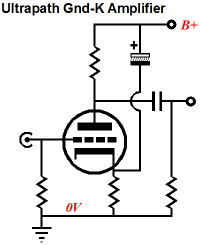
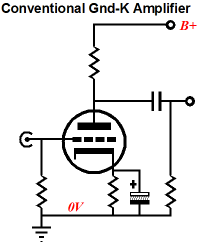
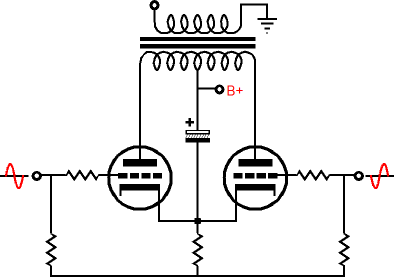
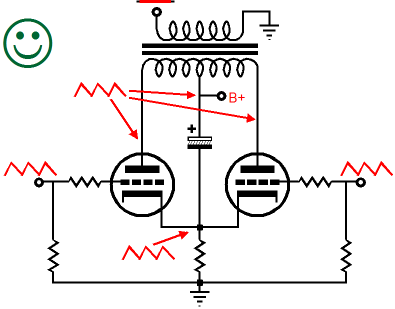
All the examples from blog 147 were single-ended, but shifting the cathode bypass capacitor's termination to the B+ connection can also be performed in a push-pull amplifier, as we can see below.
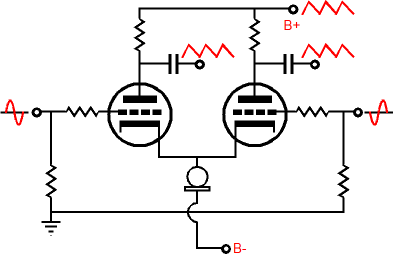
Well, is such an amplifier worth trying? Sure it looks a bit silly, but would prove noisier than the conventional push-pull amplifier, as the output transformer’s primary would see a common-mode, power-supply noise signal across its primary's leads. Of course, a perfect null is only posible with perfectly-matched output tubes and a strict class-A mode of operation, for if one output tube cuts off, the power-supply noise cannot cancel in the output transformer. Obviously, the output stage does not exist in a vacuum, as it must receive its input signal from the amplifier’s front-end circuitry. Now, let’s imagine a simple differential amplifier serving as the gain stage and the phase splitter at once. With a differential amplifier, if the common cathode resistor’s value is large or if a constant-current source is used, then the differential amplifier’s output signal will effectively be “Ultrapathed,” as all the power-supply noise will be superimposed on the output signal because of the differential amplifier’s supremely poor PSRR. A calamity? Not so, if the output stage holds an Ultrapathed output stage. The differential amplifier and the Ultrapathed output stage effectively use the B+ connection as the “ground” reference.
The signal cascades from the circuit above to the one below.
Note that adding an RC power-supply filter to the input stage would incease the noise delivered to the speaker. So is this the ultimate answer to push-pull amplifier design? No, but it is a clever way to make a fairly good and cheap push-pull power amplifier. Ideally, the B+ connection should be, in AC terms, indistinguishable from ground and we would never have to worry about having to switch from ground reference to B+ reference. But then if this were an ideal world, last October would have been much easier on the soul.
Ultra White Cathode Follower
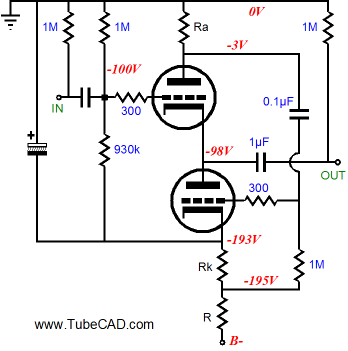
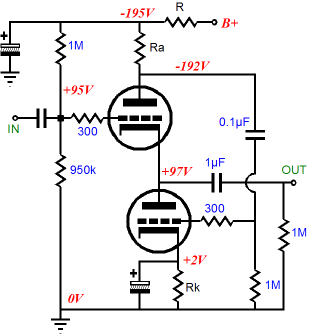
Note how the input, the output, and the bypass capacitor’s termination are referenced to ground. Also note how the two cathode resistors in series work to smooth away the negative power supply rail’s noise at the bottommost cathode. Now, just for conceptual kicks, let’s look at the same White cathode follower with a positive power supply.
Note that the same cathode-to-plate voltages and idle current obtain.
Aikido White Cathode Follower
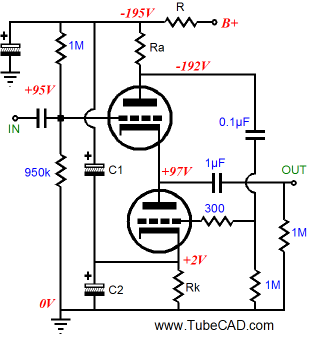
Aikido White Cathode Follower Capacitors C1 and C2 inject the correct amount of power-supply noise to achieve a power-supply-noise null at the output. Using 6DJ8/6922/ECC88 tubes, the ratio was 8 to 1 in favor of capacitor C1 over C2, for example 100µF for capacitor C2 and 800µF for capacitor C2. Why? I could not mathematically determine why that ratio proved effective, so I have not mentioned it here. No doubt, once the formula is found, it will seem embarrassingly obvious. Next Time // JRB
|
High-quality, double-sided, extra thick, 2-oz traces, plated-through holes, dual sets of resistor pads and pads for two coupling capacitors. Stereo and mono, octal and 9-pin printed circuit boards available. 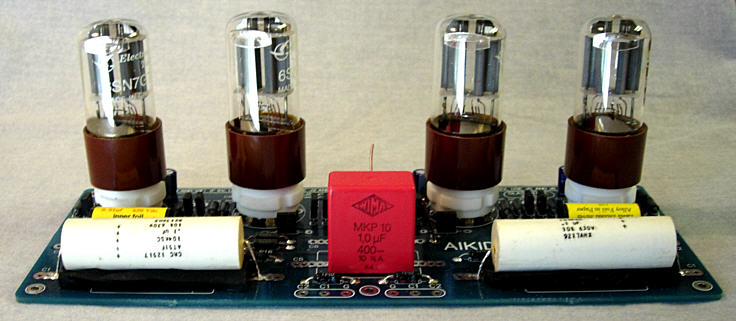 Aikido PCBs for as little as $24 http://glass-ware.stores.yahoo.net/
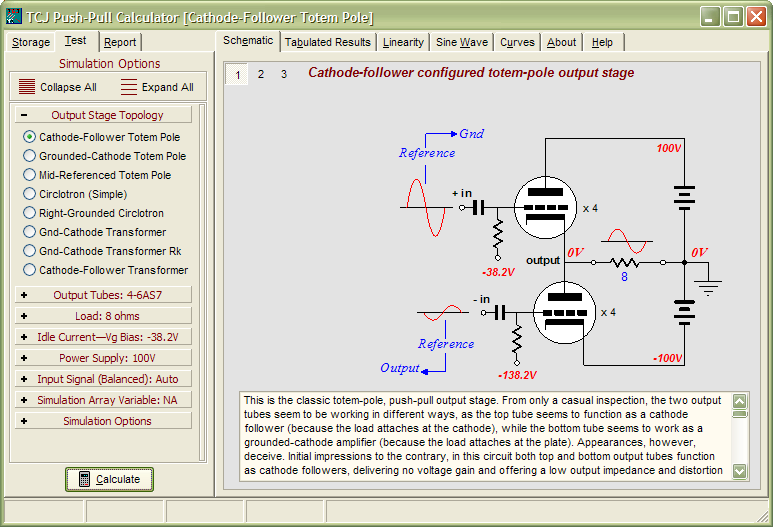
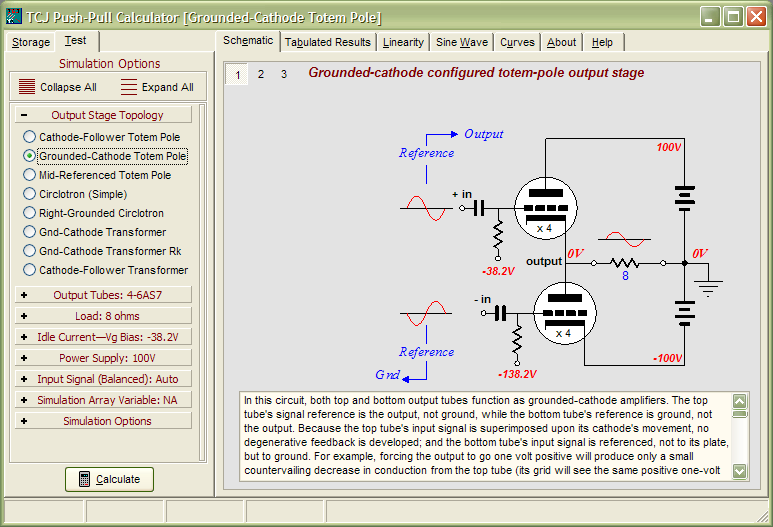
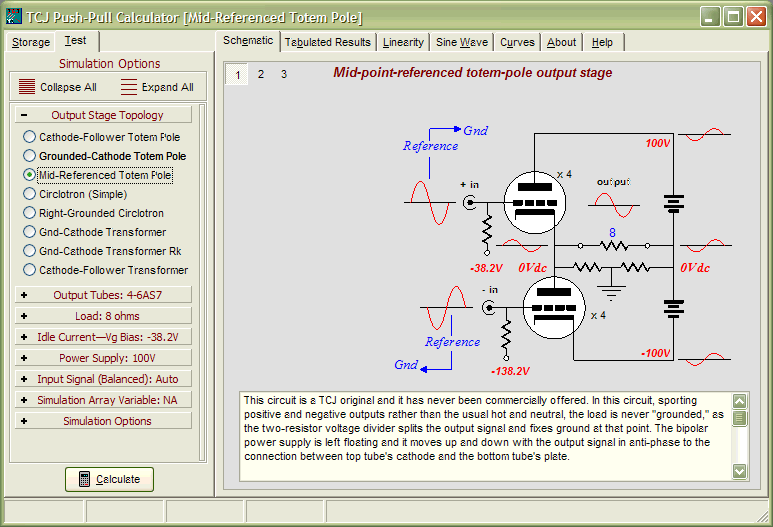
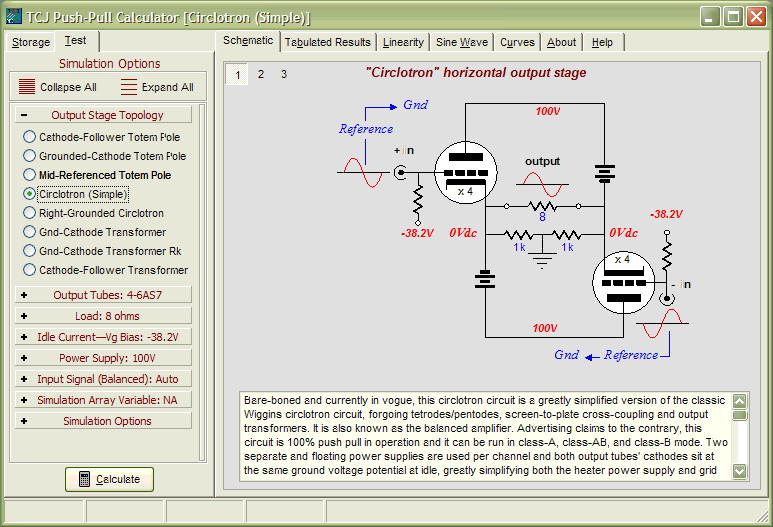
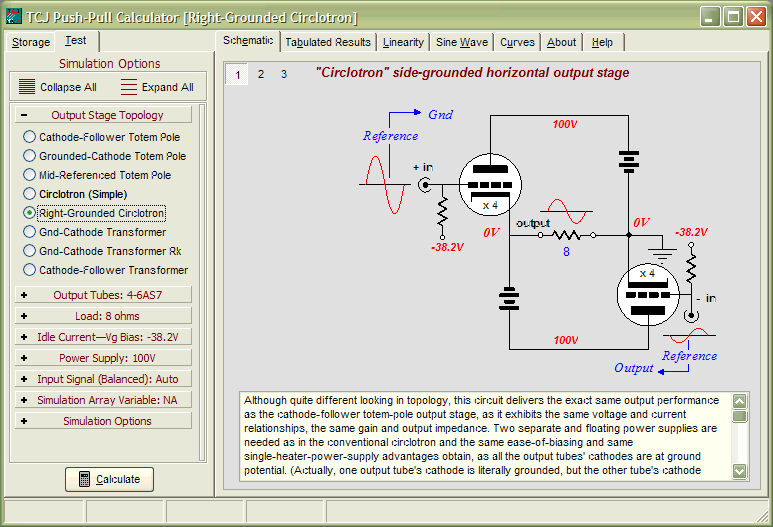
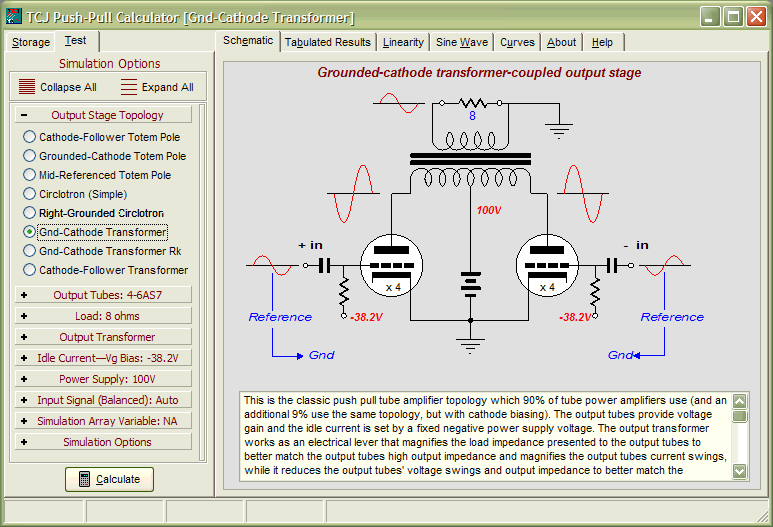
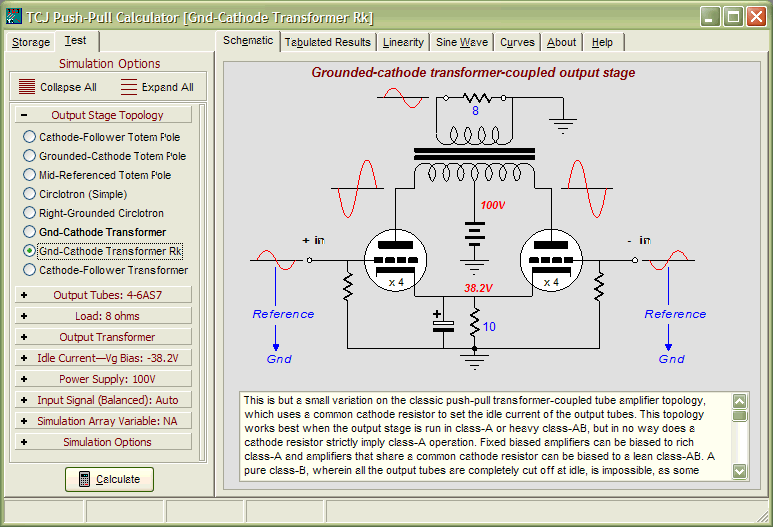
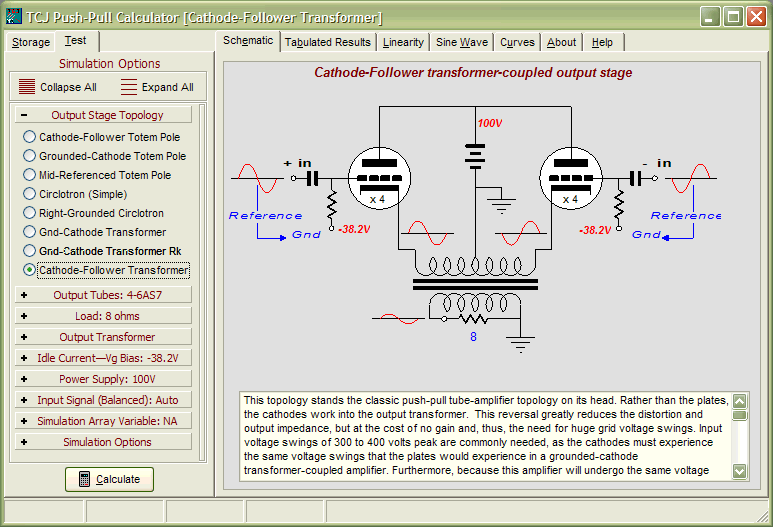
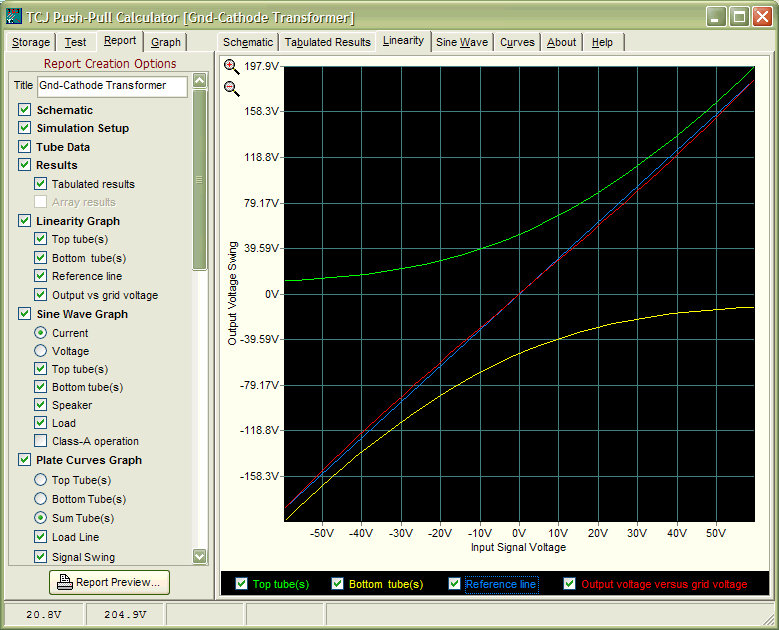
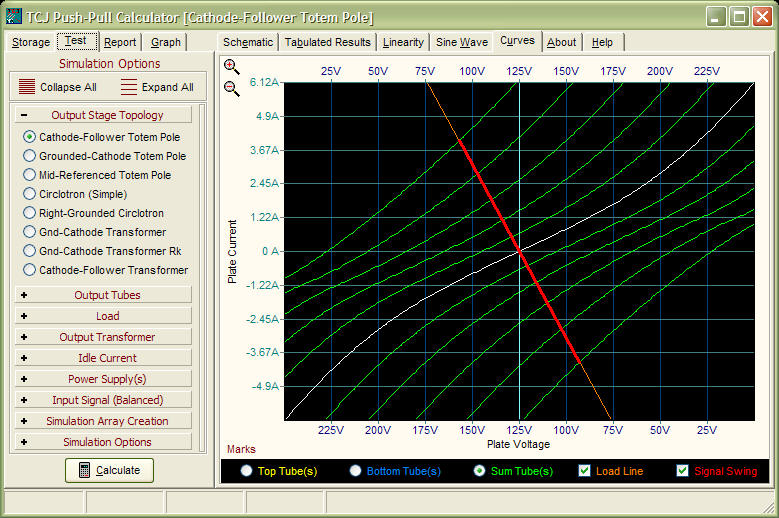
& get an extremely powerful push-pull tube-amplifier simulator for TCJ Push-Pull Calculator
TCJ PPC Version 2 Improvements Rebuilt simulation engine *User definable
Download or CD ROM For more information, please visit our Web site : To purchase, please visit our Yahoo Store:
|
|||




| www.tubecad.com Copyright © 1999-2008 GlassWare All Rights Reserved |